
The Secret Art of the Carpenter's Plane by Yamaoka Tesshu

The following essay is reprinted from the book The Sword of No Sword: Life of the Master Warrior Tesshu by Yamaoka Tesshu, translated by John Stevens.
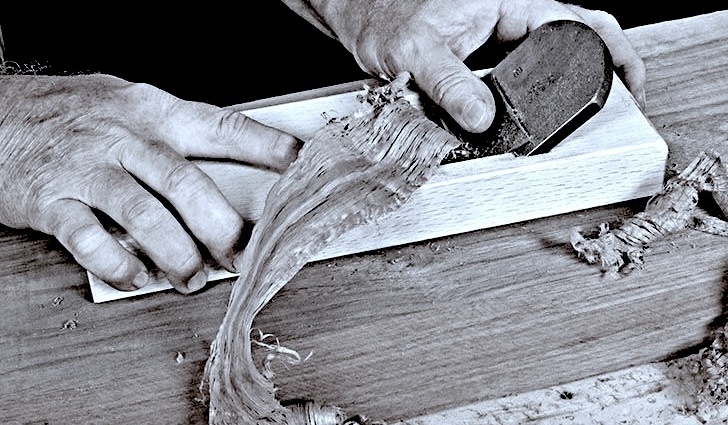
Use of a carpenter’s plane involves three operations: rough, intermediate, and fine. In rough planing the body is braced, the abdomen tightened, the hips set, equal amounts of strength put into the hands, and the plane made. In short, strength is put into the entire body and one cannot relax. If one does not move forcefully a rough planning cannot be done.
Next an intermediate planing is made. This time one must not use all his power. The natural touch of the hands controls increases and decreases in pressure. This level is preparation for the next step. However, if the continuity from rough planing to intermediate planing is broken through a lack of concentration the work cannot be properly executed.
From intermediate planing one moves to fine planing. Here, irregularities left from the previous steps are smoothed out. If it happens to be a pillar one is working on, one must go from top to bottom with one turn of the plane. While progressing from top to bottom, it is essential to keep the heart in perfect order. If the heart is not in order, various irregularities will appear and the work cannot be completed successfully. Proper control is the key.
Mind, body, and technique must function together in the same manner. “Mind, body, and technique” correspond to “plane, carpenter, and pillar.” If one thinks the carpenter does the planing, of what use is the plane? If one thinks the plane does the planing, of what use is the pillar? Mind, body, and technique function together in a way similar to that of plane, carpenter, and pillar; if that interdependence is not understood, one will not be able to produce a good pillar regardless of how long one practices with a carpenter’s plane.In order to create a good pillar, rough planing must be practiced first. Once that step is mastered, the next two steps can be mastered.
Fine planing is the “secret technique.” That secret technique is nothing special. Mind, body, and technique are ultimately forgotten and one proceeds smoothly until the work is complete. To no longer think about finishing the plane and to no longer talk about technique or anything else is a marvelous state. It is futile to ask how to attain this - fine planing can only be learned by oneself; it can never be gotten from another.
April 1884